Our responsibility
Sustainable and ethical action is a matter of course for us.
Learn more
Economy
On 20 February 2026, the US Supreme Court overturned Donald Trump’s trade and tariff policy and declared a large part of the punitive tariffs imposed so far to be unlawful. As a result, the average tariff burden is set to fall significantly. For companies and consumers, this means a certain short-term relief, even though not all special tariffs – for example on strategic industries – are affected. At the same time, the US government announced a new, initially temporary base tariff of 10% on almost all imports, with the option of an increase to 15%. This measure is based on existing trade law provisions and is likely to remain subject to legal dispute. For the economy, this creates a field of tension: on the one hand, the repeal of earlier measures reduces the burden on private households – according to estimates, the additional costs recently amounted to around USD 1,000 per household and could now fall significantly. On the other hand, planning uncertainty remains high, which weighs on investment and could further fragment supply chains. There is also a fiscal dimension. Tariffs represent an important source of government revenue. If these partially fall away, pressure on the public budget to tap alternative financing sources increases. In an environment already characterised by high deficits, this reinforces the debate about additional indebtedness. Overall, stabilising effects on consumption are likely in the short term, while in the medium to long term uncertainty about future trade policy could dampen growth. A clear trend towards more free trade is not discernible; rather, the formation of regional trading blocs is likely to continue.
Equities
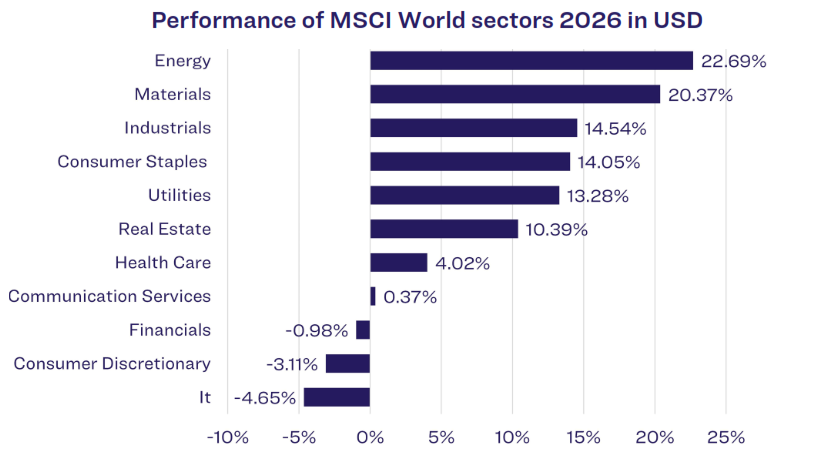
International equity markets initially reacted cautiously to this judicial U-turn. In the US, the major indi-ces edged lower following the announcement of the new tariff plans, while most Asian markets were able to post gains. In Europe, the picture was mixed, with the Swiss market proving relatively resilient. What stands out is the ongoing sector rotation. Whereas in recent years large technology stocks in particular have dominated, the focus is increasingly shifting towards broader market positioning. In addition to cyclical sectors, defensive segments such as utilities are gaining in attractiveness. Even long-neglected areas such as basic materials and energy are once again seeing capital inflows.
European investors were overall rather subdued. The dollar lost around 13% in value both against the Swiss franc and the euro. Although the S&P 500 rose by 16%, currency-adjusted returns were only about 3%. Overall, a few winners in 2025 overshadowed a large number of underperformers. The question arises whether this pattern will continue in 2026. Risks include particularly the high valuations in the stock market and the possibility of the AI bubble bursting. A significant decline in technology stocks could lead to investment cuts, which in turn could weigh on the broader market, as many companies—also outside the IT sector—are now benefiting from AI investments. However, there are also opportunities. The topic of Artificial Intelligence is likely still in its early stages of development and could continue to provide market impulses over a longer period, with other sectors increasingly benefiting as well. Furthermore, earnings growth of around 14% is expected for the US market in the coming year, which will not be solely driven by the “Magnificent 7,” but by the broader market. These factors support the possibility of positive stock markets and increasing market breadth in 2026. In addition to these aspects, there are other opportunities and risks that could influence the development of the stock markets. We will address these in more detail in the following sections.
Economy
Based on the following scenario, a recession may occur in the US: Private consumption declines due to falling savings and rising job losses. At the same time, interest rates and mortgage rates remain high, putting pressure on real estate prices and increasing borrowing costs. However, we currently assess this scenario as unlikely and instead expect the continuation of the so-called Kshaped economic development. In such an economic environment, individual sectors, companies, and population groups will increasingly develop differently. In the upper arm of the K-curve (recovery), certain sectors—particularly technology, software, and financial services—along with high-income households, which quickly recover and show significant growth, will benefit. In contrast, in the lower arm (downturn), other sectors such as hospitality, retail, or tourism will either stagnate or lose further economic substance. Low-income
households are particularly affected by this development. The K-shaped
economy thus exacerbates social and economic inequality. While wealthy
groups benefit from rising asset values, others suffer from a loss of purchasing power and increasing debt. This economic trend characterized 2025 and is likely to continue in 2026, further intensifying the divergence between outperformers and underperformers in the stock markets.
Bonds
On May 15, 2026, Jerome Powell’s term as Chairman of the US Federal Reserve (Fed) will end. Although Powell was appointed during US President Donald rump’s first term, Trump repeatedly criticized the work of the Fed Chairman during his second term. From his perspective, Powell followed too restrictive a monetary policy and should have significantly lowered interest rates. Against this backdrop, the US President is considering various potential successors who are politically aligned with him in order to increase his influence on monetary policy.
Equities
Regionally, a reallocation away from heavily weighted US investments towards Europe and selected emerging markets has been underway for some time. However, the renewed uncertainty surrounding tariffs could temporarily slow the recently initiated shift from large-cap stocks to mid- and small-caps. Overall, though, the increasing diversification points to a healthier market structure. The key question remains whether political uncertainty will translate into concrete earnings revisions, or whether compa-nies will be able to offset the burdens through price adjustments and supply chain optimisation.
Bonds
The immediate reaction in the US bond market was moderate. Yields on ten-year government bonds moved only slightly and are holding at just above 4%. In the medium to longer term, however, fiscal developments are likely to move more into focus. Should the repeal of earlier tariffs lead to a substan-tial loss of revenue and, at the same time, new measures generate less income than planned, the Treasury might be forced to issue additional bonds. An increasing supply of government bonds would, in principle, imply upward pressure on yields. For investors, this creates a field of tension between economic cooling – which would generally argue for lower interest rates – and rising government debt, which could require higher risk premia. Corporate bonds have so far remained stable, supported by the expectation that the relief on import costs could underpin profit margins. Overall, the bond market remains sensitive to fiscal policy developments and potential rating discussions.
Currencies
In the foreign exchange market, the US dollar initially lost ground following the latest decisions, but was able to stabilise again in part. Structurally, several factors argue for a continued tendency towards weakness: on the one hand, both the budget and trade deficits are widening simultaneously; on the other hand, political uncertainty is increasing. Both have historically tended to weigh on a currency. The Swiss franc is benefiting in this environment from its role as a safe haven. The increased demand reflects the desire for stability in an environment marked by political shifts in direction. Against the euro, the franc is also firm, although the development is strongly influenced by relative movements in the dollar. For exportoriented economies, exchange rate developments remain a key factor, especially as long as trade policy negotiations – for example on bilateral agreements – are ongoing.
Alternative Investments
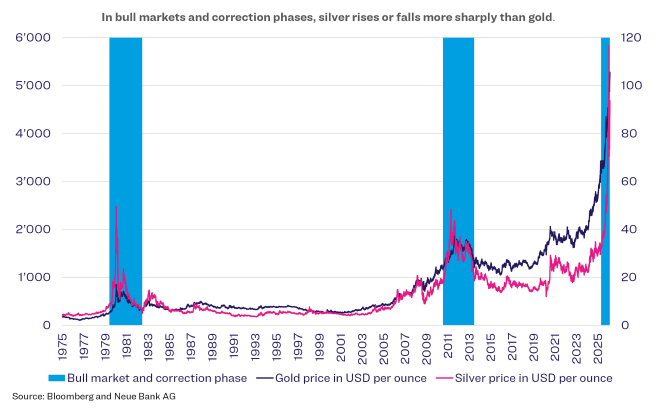
Precious metals reacted positively to the increased economic and trade-policy uncertainty. Gold and silver at times posted significant gains, supported by a weaker US dollar and ongoing geopoliti-cal tensions. In an environment of high government debt, structural budget deficits and rising po-litical polarisation, they continue to fulfil their role as diversification instruments and stores of value. The movements are particularly pronounced in the case of silver. Compared with the gold market, the silver market is considerably smaller and has a much lower average daily trading volume. As a result, even a relatively small amount of capital can trigger stronger price swings. Historically, sil-ver has tended to rise disproportionately in bull markets, while coming under more pressure than gold during correction phases. This pattern was observed both in the late 1970s and during the commodity boom around 2011, and can also be seen again at present. The recent pullback within the silver euphoria temporarily weighed on the gold price as well, although the pace of the gold price increase had also been very strong lately.