Our responsibility
Sustainable and ethical action is a matter of course for us.
Learn more
Economic outlook
The global economy is in a phase where capital has a price again and government debt levels continue to rise. In the United States, the public debt-to-GDP ratio stands at around 124%, and the IMF expects cumulative budget deficits of more than USD 13 trillion by 2030. In the euro area as well, governments are likely to take on around EUR 3 trillion in additional debt by 2030.
This combination of high debt and higher capital costs is shaping an expensive capital world and is increasingly affecting growth and investment. The economic situation remains mixed. In the United States, a resilient economy supported by solid consumer spending and a still strong labour market continues to underpin growth. At the same time, inflation is picking up: the Personal Consumption Expenditures (PCE) price index is 4.1% above the previous year, with the core rate at 3.4%. The energy price shock since the start of the Middle East conflict is now clearly feeding into service prices, particularly transport services. In Europe and Switzerland, momentum is more subdued. Germany is struggling with weak industry and stalled investment activity; the Ifo real-time indicator already signals slightly negative growth for the third quarter. In Switzerland, the economy remains stable; very low yields and the strong franc reflect an environment of high risk aversion. Against this backdrop, the key question is less how much debt states can theoretically afford, but how much they are willing to carry in practice. High debt limits fiscal flexibility, especially when defence spending and social security costs are rising at the same time. For the economic outlook, this means less room for growth-supporting fiscal measures and a greater importance of private investment and productivity gains – a core feature of the expensive capital world.
Equities
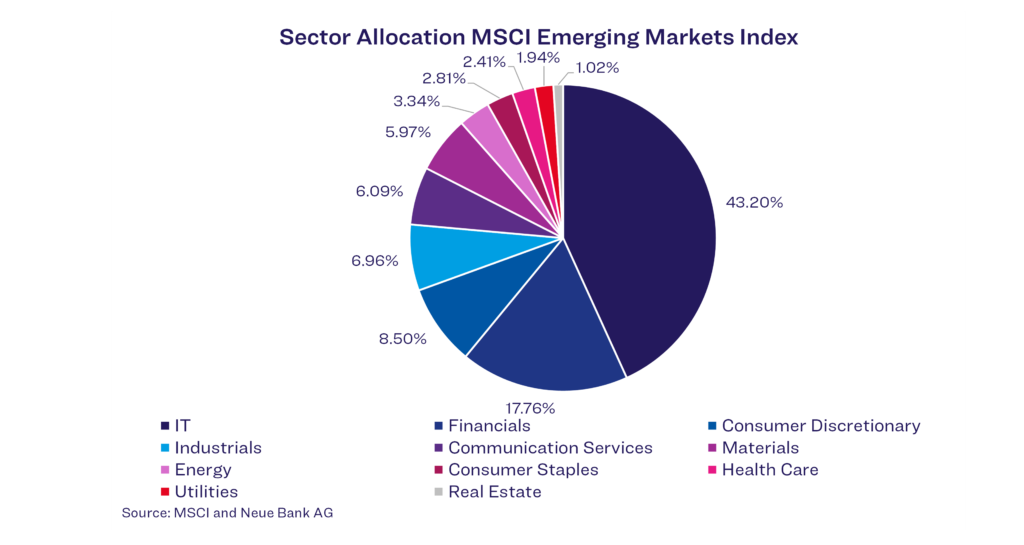
In equity markets, the rising cost of capital is particularly visible in how AI companies are valued. The AI infrastructure theme is real: semiconductors, memory, optical components and data centres are experiencing strong revenue and earnings growth. At the same time, valuations are often demanding, and even slightly disappointing news can trigger significant price corrections. In addition, market concentration is high: major indices such as the MSCI Emerging Markets Index now carry a substantial exposure to technology, semiconductors and AI infrastructure, with a weighting of around 43%.
Equities
The IT sector is also dominated by AI companies such as Samsung Electronics and SK Hynix from South Korea and Taiwan Semiconductor from Taiwan, which together account for nearly 29% of the index. Anyone investing in the market via ETFs is therefore increasingly exposed to a narrow segment of winners. At the same time, equities play a central role in wealth accumulation. In Germany, shares held by private households were up 10.6% year on year as of end-2025, while savings deposits generated little return and bonds delivered significantly lower yields. In an expensive capital world, too low an equity allocation therefore becomes a structural disadvantage. For equity investing, this means participating in the AI trend without concentrating the portfolio on it. The key drivers are quality, strong balance sheets and pricing power – combined with broad diversification that also includes companies whose long-term value is currently underestimated by the market.
Bonds
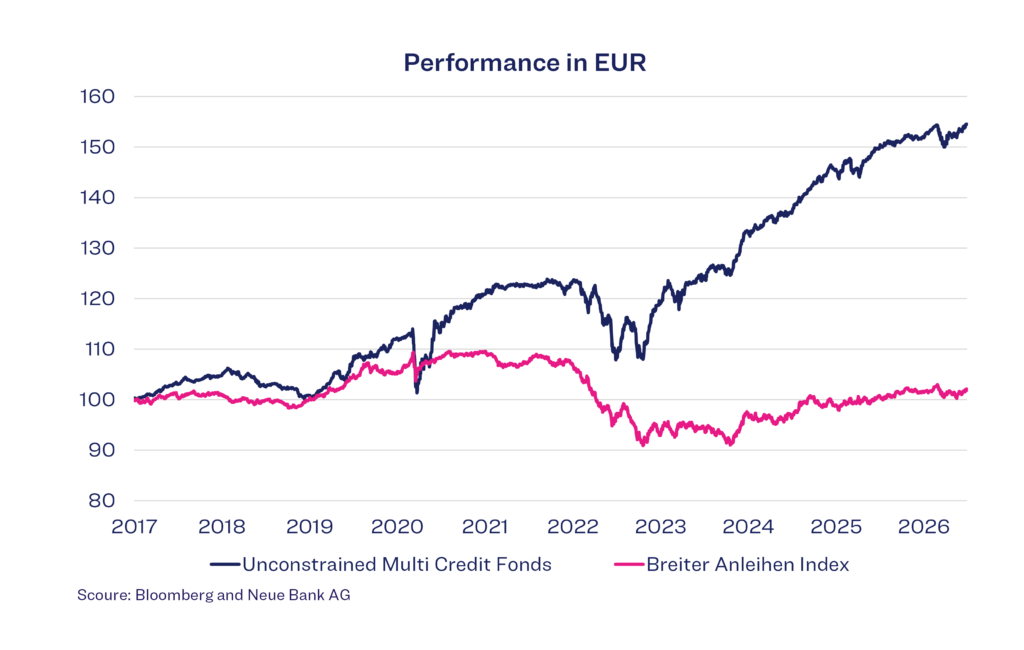
The bond market illustrates the expensive capital world particularly clearly. Yields on 10-year US government bonds are at around 4.5%, above the level seen at the end of 2025. This reflects persistently high US core inflation and expectations that policy rates will be raised further and then remain at elevated levels for an extended period. At the same time, global debt levels continue to rise: cumulative budget deficits in the United States and the euro area are expected to increase significantly again by 2030. Fiscal space is therefore becoming tighter, raising the question of how “safe” government bonds will remain in the future. However, experience shows that high debt ratios do not automatically lead to sovereign default. Countries such as Japan or the United Kingdom have carried debt levels well above 100% of GDP for decades without losing their ability to meet obligations. In developed economies with strong institutions and their own currency, government bonds are therefore still perceived as relatively low risk. Nevertheless, high debt and associated interest costs significantly constrain fiscal flexibility: funds used for debt servicing are unavailable for education, infrastructure, defence or social security. In the expensive capital world, the risk is less an abrupt default event and more a gradual loss of flexibility and growth-supporting investment. Against this backdrop, passive buy-and-hold strategies in fixed income are no longer sufficient. Traditional indices overweight the most indebted issuers regardless of quality. Investors closely tracking benchmarks therefore take on a concentration in highly leveraged issuers while forgoing active use of valuation differences. An active approach is required that prioritises price and quality, analyses relative valuations across segments and actively manages duration, credit quality, regions and risk premia. For this reason, we focus on so called multi-asset or unconstrained bond solutions that can utilise the full spectrum of the bond market. As shown by the development below, this active approach has delivered significant outperformance versus the broad index over time.
Currencies
In currencies, it is clearly visible how the expensive capital world is reshaping confidence in reserve currencies and the structure of foreign exchange reserves. In 2025, the United States attracted net inflows of USD 1,552 billion from non-US investors into long-term US securities. The strong role of the US dollar is based not only on the size of the US economy and its capital markets, but also on its perception as a safe-haven asset in a politically, institutionally and macroeconomically stable environment. This confidence has, however, shown cracks under President Trump – for example through the “Liberation Day” with aggressive tariff threats, the suggestion of annexing Greenland in-cluding the use of military force against allies, and the conflict with Iran. Such episodes are particularly sensitive in an expensive capital world, where high debt levels and interest rates already weigh on confidence. At the same time, the structure of global foreign exchange re-serves has shifted significantly. The gold share of central bank reserves has risen from just under 10% in 2015 to around 28% at the end of 2025, while the US dollar share has declined from 58% to just above 40%.
Central banks are responding to geopolitical uncertainty, high public debt and concerns about the long-term stability of individual currencies. Gold is increasingly used as a long-term store of value to reduce dependence on the US dollar. For investors, this means that currency risk in the expensive capital world is no longer defined only by interest rate differentials, but increasingly by political stability, debt levels and central bank reserve policy.
Alternative investments
In energy, commodities and precious metals, the expensive capital world becomes particularly visible. Brent crude oil has fallen significantly after a sharp rise to nearly USD 120 in spring and is now trading at around USD 72 per barrel, the lowest level since late February. In the short term, this eases inflation pressures and reduces the immediate need for action by the US Federal Reserve. At the same time, volatility remains high: the energy price shock has already clearly fed through into other price areas. Precious metals are also caught between interest rate expectations and inflation dynamics. The gold price has fallen by around 10% since early June, while silver has declined by more than 20%. Higher US interest rate expectations and a stronger dollar are weighing on gold. Nevertheless, gold retains its role as an “ultimate currency” and long-term stability anchor. Geopolitical uncertainty, rising public debt and a weaker growth environment combined with moderately rising in-flation make gold a meaningful component of a diversified portfolio. For investors, this means energy and commodity prices remain key drivers of inflation and interest rate dynamics, while precious metals act both as sentiment indicators and diversification tools. A selective allocation to gold and other real assets can help hedge portfolios against unexpected inflation and rate shocks, but requires tolerance for higher volatility. In the expensive capital world, alternative investments are both an opportunity and a challenge: they offer diversification, but are closely linked to the same interest rate, debt and inflation forces that shape the broader investment universe.

