Our responsibility
Sustainable and ethical action is a matter of course for us.
Learn more
Economic Activity
The US economy continues to demonstrate resilience. The Purchasing Managers’ Index for the manufacturing sector remains above the growth threshold, while new orders also point to continued expansion. The labour market remains robust. At 4.1%, the unemployment rate is only slightly above the lowest levels seen in recent decades. Employment costs are still rising by 3.4%. This reflects not only delayed wage adjustments but also higher social security contributions and employee benefits. At the same time, the increase in unit labour costs has eased significantly to 1.4%. Labour market-related cost pressures have therefore diminished, but have not yet disappeared completely.
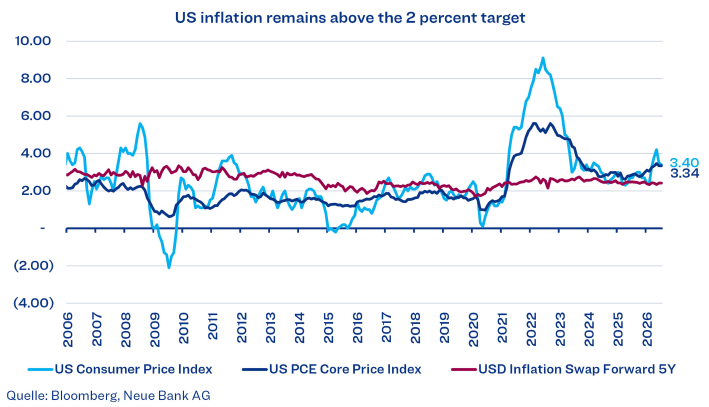
At the same time, inflation has not yet reached the level targeted by the Federal Reserve. Consumer prices (CPI) and core PCE inflation remain well above the 2% target. Long-term inflation expectations, by contrast, are considerably more moderate and remain below current inflation rates. This suggests that market participants expect inflation to ease further, although the adjustment will take time. The new Fed Chair, Kevin Warsh, also described this development as “sticky inflation”, meaning inflation that remains persistent and declines only gradually. Against this backdrop, the Federal Reserve has raised its policy rate for the first time again. The resilient economy gives it room to continue addressing price pressures without choking off economic growth. Markets are also pricing in further rate hikes.
Bonds
Yields on US Treasury bonds have recently risen across all maturities. At the long end of the curve, in addition to resilient economic growth and persistent inflation, high US government financing needs are also reflected. Increased borrowing has weighed on the prices of long-term bonds and pushed their yields higher. As a result, the yield curve has become steeper. In historical comparison, however, the yield premium of longer maturities over short-term bonds remains moderate, particularly when periods of inversion are excluded. Investors are therefore only being compensated to a limited extent for the additional duration risk. For this reason, we also prefer shorter-maturity corporate bonds. They offer attractive yields with lower interest-rate risk if inflation remains persistent.
Equities
Rising policy rates are often viewed by financial markets as a headwind for equities. Higher interest rates increase companies’ financing costs and make bonds more attractive relative to equities. In addition, future corporate earnings are discounted at a higher rate. It therefore seems reasonable to assume that rising policy rates inevitably lead to falling equity prices.
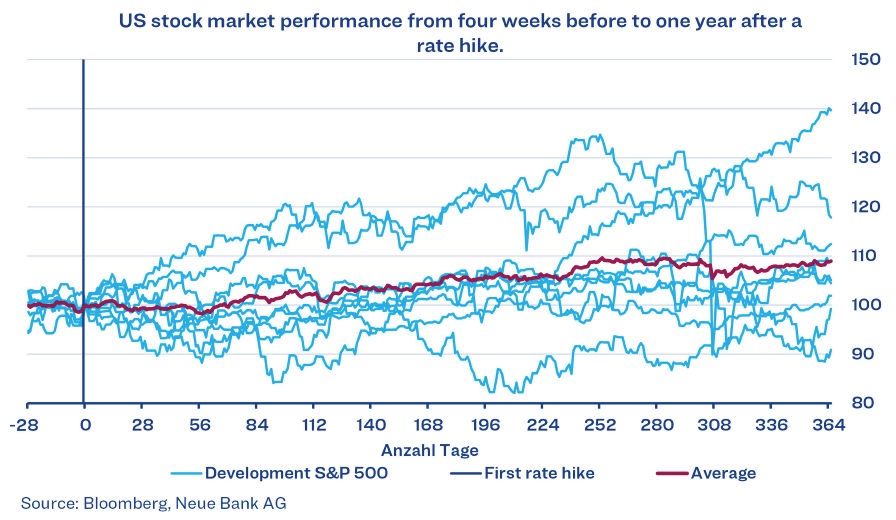
A look at the Federal Reserve’s past rate-hiking cycles paints a more nuanced picture, however. Since 1986, the S&P 500 has on average remained largely stable around the start of a rate-hiking cycle. In the months that followed, the index even gained on average. While the range of outcomes was considerable, this does not point to a systematic and immediate correction. What matters is the economic environment in which interest rates are rising. If policy rates are raised when the economy is robust and companies are able to increase their earnings, this does not necessarily have to be negative for equities. In such an environment, higher interest rates can be offset by solid earnings growth. Equity markets therefore do not respond solely to the level of interest rates, but above all to why rates are rising and how much the economy is being affected as a result. The Neue Bank traffic light remains on light green, and accordingly, we maintain a slight overweight in equities.
Alternative Investments
For the past three months, we have been invested in a commodity ETF excluding agricultural commodities. It also includes fossil fuels, which have recently been among the key drivers of inflation. The development has been significantly influenced by the war in the Gulf and the resulting closure of the Strait of Hormuz. A prolonged disruption of this important transport route would increase uncertainty in energy markets. This could lead to further increases in the prices of fossil fuels. In such a scenario, our investment would continue to provide a certain degree of inflation protection.
Currencies
The resilient US economy and persistent inflation point to interest rates remaining comparatively high in the USD area. The recent rise in yields therefore increases the attractiveness of US dollar investments. At the same time, a stable economic environment provides less incentive to shift capital into the Swiss franc, which is traditionally regarded as a defensive currency. The Swiss National Bank is not expected to raise interest rates for the time being, as inflation remains within the
target range. This supports the USD/CHF exchange rate.
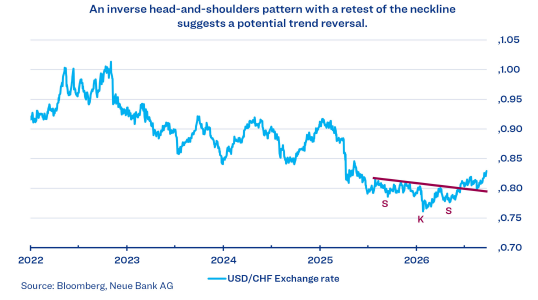
Technical analysis also supports this view. Over the past 12 months, an inverse head-and-shoulders pattern has formed, which gained further significance following a test of the neckline in the second half of August. We closed our tactical USD hedges in portfolios with CHF as the reference currency at the end of June and are maintaining this positioning.