Our responsibility
Sustainable and ethical action is a matter of course for us.
Learn more
Bonds
The nearly four decade long decline in interest rates appears to have come to an end. After a prolonged period in which falling yields made government bonds a reliable source of performance and diversification, the environment has shifted materially. Elevated public debt levels, persistent fiscal deficits and significantly higher refinancing costs point towards a structural setting of higher interest rates going forward.
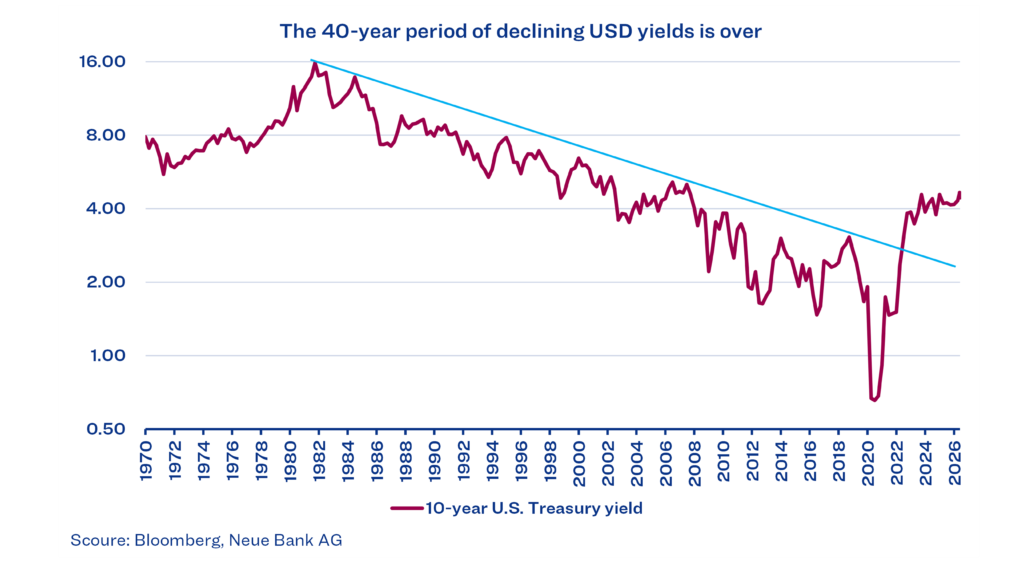
The full impact of this development is only partially visible at present. Many governments will need to refinance maturing low yield debt over the coming years at significantly higher rates. As a result, interest burdens are set to rise gradually further. The starting position is particularly challenging for countries with high debt ratios, large fiscal deficits or deteriorating credit fundamentals. These include, among others, Japan, the United States, France and Italy. Even within developed markets, sovereign credit quality is therefore likely to become an increasingly important differentiating factor. For heavily indebted sovereigns, there are only a limited number of viable paths out of the debt dilemma. A period of elevated inflation may be politically more tolerable, as it reduces the real debt burden and, with sufficiently strong nominal growth, can lower the debt-to-GDP ratio. Other potential measures include currency depreciation, financial repression, higher taxation, reduced public spending, structural growth initiatives or, in extreme cases, outright debt restructuring. For investors, this implies that part of the adjustment may occur through real purchasing power erosion, lower real returns, or more direct interventions in capital markets. Against this backdrop, long-dated government bonds have lost part of their traditional protective characteristics. The risk is no longer limited to classic credit risk, but increasingly extends to interest rate and refinancing risk. Long-duration sovereign bonds offer little protection against rate shocks and entail exposure to sovereigns whose fiscal profiles are, in some cases, deteriorating. We began making initial adjustments approximately 24 months ago. Since then, we have gradually reduced exposure to government and quasi-sovereign bonds and selectively increased allocation to high-quality corporate credit. This deliberately assumed credit exposure should not be interpreted as a broad increase in risk, but rather as a targeted diversification away from concentrated interest rate and sovereign risk. Fixed income remains a core portfolio component. However, its role has evolved: the focus is no longer on allocating to sovereign bonds or quasi-sovereign issuers once regarded as risk-free, but rather on an active combination of duration management, issuer quality and selective credit exposure.
Economic outlook
The global economy continues to operate in a challenging environment. Geopolitical conflicts, high energy prices, fragile supply chains and persistent inflation are weighing on the outlook. At the same time, the starting point for monetary and fiscal policy has become significantly more constrained. The traditional central bank response to weakening economic data is no longer readily available. As long as inflation remains elevated, monetary authorities are unable to shift decisively towards an expansionary stance. Meanwhile, fiscal policy in many countries is constrained by high public debt levels and rising refinancing costs. This amplifies the issue described in the fixed income section: higher interest rates are not only a market phenomenon, but are increasingly becoming a real economic headwind.
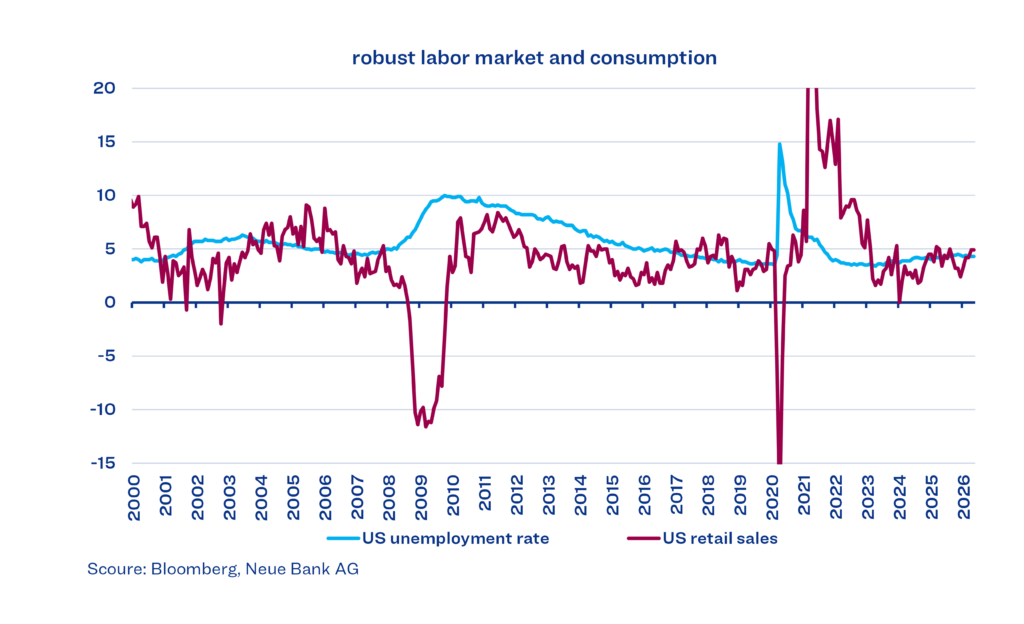
The United States remains the key lead market in this context. Despite initial signs of cooling, the US economy continues to benefit from a solid labour market and resilient consumer spending.
Equities
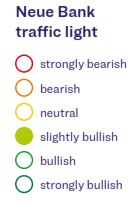
Equity markets remain robust despite geopolitical risks, higher interest rates and mixed economic data. The underlying indicators of the Neue Bank indicator framework have improved, resulting in a shift in the signal from neutral to light green. We have taken this opportunity to moderately increase equity exposure. On the equity side, we have added positions in emerging markets, among others.
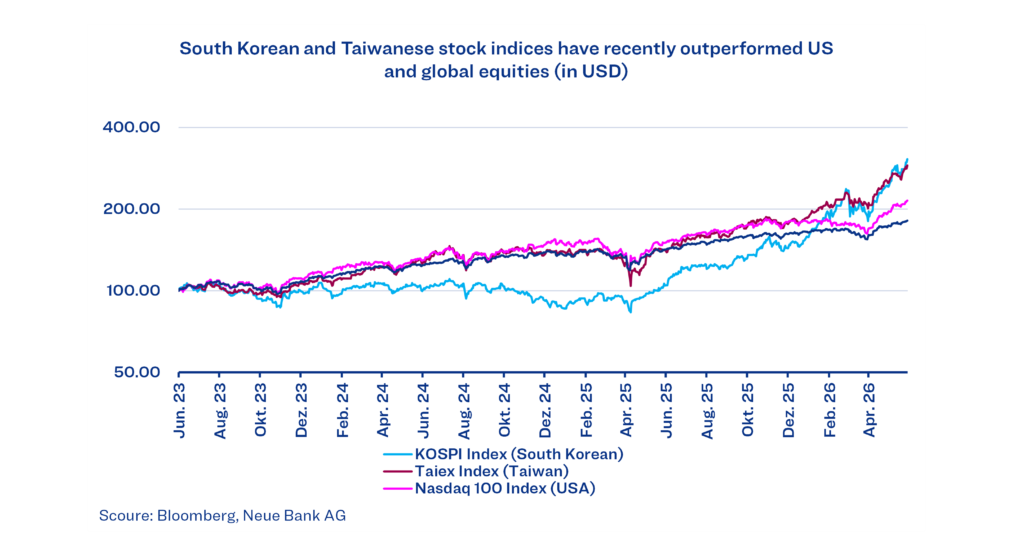
Structural growth themes such as artificial intelligence, semiconductors, automation and data centres are not only supporting US equity markets. Selected emerging markets are also benefiting from these developments.
Currencies
The Japanese yen (JPY) and the Swiss franc (CHF) represent two contrasting sides of the same broader theme. Japan is under pressure, as high public debt levels and only limited scope for monetary tightening constrain the Bank of Japan’s policy flexibility. Although a weaker yen would normally justify higher interest rates, the central bank remains cautious. Foreign exchange interventions may temporarily slow the trend, but they do not address the underlying structural issue. The Swiss franc, by contrast, continues to be in demand as a safe-haven currency in an environment of geopolitical uncertainty and fragile sovereign balance sheets. For Switzerland, this is a double-edged development. While a strong franc helps contain imported inflation, it weighs on the export sector. This creates a difficult policy trade-off for the Swiss National Bank, which must safeguard price stability without allowing excessive currency appreciation.
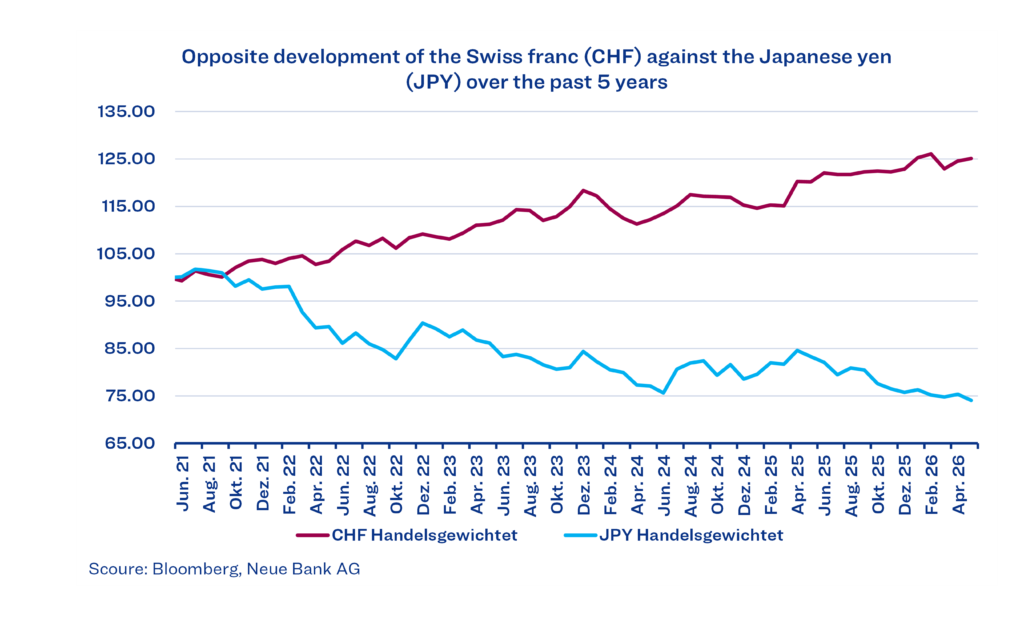
This reinforces the view that exchange rates are increasingly becoming a reflection of confidence, credit quality and monetary policy flexibility. While the JPY highlights the constraints of a highly indebted economy, the CHF continues to reflect Switzerland’s defensive characteristics.
This is also reflected in our active currency positioning. Specifically, we have hedged JPY exposure in our CHF, EUR and USD portfolios. In addition, within our CHF mandates, the main foreign currency risks are at least partially hedged.
Alternative Investments
Real assets such as gold remain in demand in the current environment. They can provide diversification benefits and tend to gain importance when confidence in fiat currencies, sovereign bonds and the long term sustainability of public finances diminishes.
Central banks are also increasingly repositioning their reserves. Several countries are reducing their reliance on the US dollar (USD), scaling back holdings of US Treasuries and, in parallel, increasing their gold reserves. Among the largest buyers in recent years are China, Poland, Turkey, India and Kazakhstan.
There have also been occasional sales. Russia sold gold in the context of rising military expenditures and an expanding fiscal deficit. Turkey reduced gold holdings amid an acute energy crisis and additional pressure on the lira. However, the broader picture has remained largely unchanged: sovereigns and central banks have continued to be net buyers of gold. We continue to maintain our gold positions.

