Our responsibility
Sustainable and ethical action is a matter of course for us.
Learn more
Economy
The global economy increasingly depends on the investment decisions of a small number of companies. The large US technology groups have raised their investment from USD 156 billion in 2022 to more than USD 1,000 billion today, above all for data centres and artificial intelligence. A large share of US growth now stems from this investment. The economy itself has thus become a concentration risk. According to estimates, almost half of the earnings growth in the S&P 500 now depends directly or indirectly on the investment of the hyperscalers. As long as they keep investing, chipmakers, energy utilities, the construction industry and suppliers benefit. If budgets are cut, this will hit not only the technology sector but the economy as a whole. At the same time, the environment has become more challenging. The war in the Middle East is keeping the oil price high: a barrel of Brent costs around USD 110, almost 80 per cent more than at the start of the year. Only around 8.5 million barrels of oil per day are currently flowing through the Strait of Hormuz, compared with around 20 million before the conflict. Higher energy prices are keeping inflation high. In the US, prices most recently rose by 3.4 per cent according to the measure preferred by the central bank. In September, the US Federal Reserve raised interest rates for the first time in three years, to 4 per cent, and signalled further steps. The European Central Bank has also raised its deposit rate to 2.5 per cent. Many economists expect growth to slow noticeably next year: inflation rises first, and only later does the economy suffer. In Europe, the budget crisis in France is an additional burden, where protests and political uncertainty have caused risk premiums on government bonds to rise significantly. Politically, attention is turning to the US midterm elections in early November. If the Democrats win Congress, the room for further fiscal stimulus is likely to shrink. Despite all the uncertainties, however, the economy is currently still proving robust, and high investment continues to support growth for the time being.

Equities
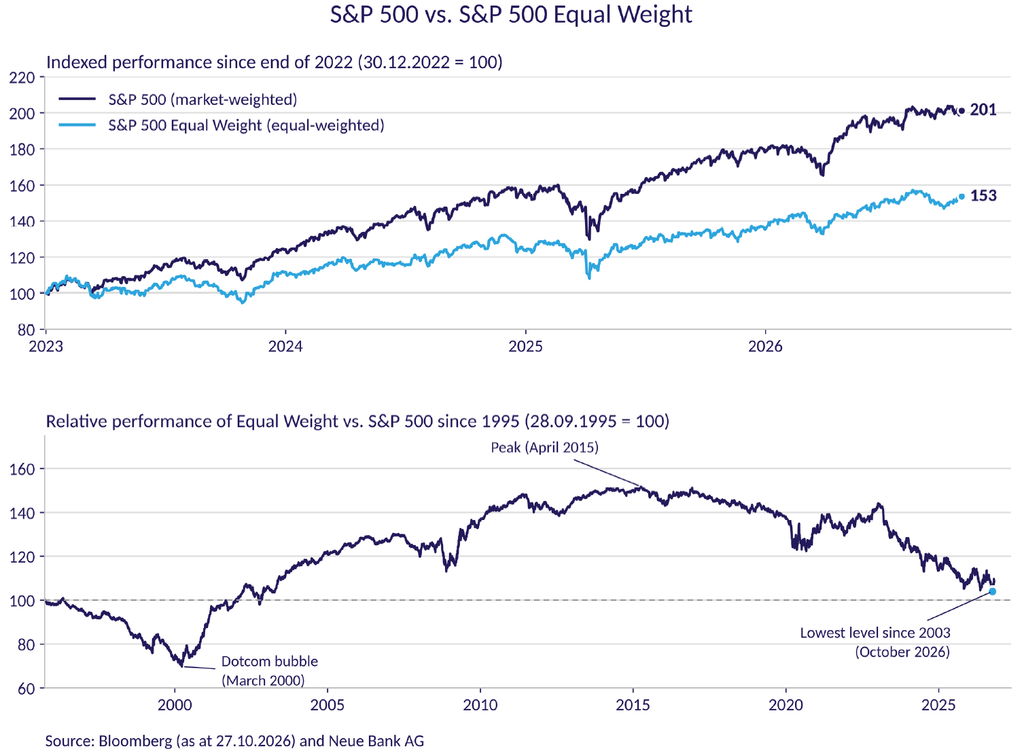
Concentration is most evident in the equity markets. The ten largest companies account for around 36 per cent of the S&P 500, and technology and communication together for around half. Nvidia alone weighs more than 8 per cent. Since the end of 2022, the S&P 500 has roughly doubled, with six hyperscalers delivering 43 per cent of this increase. The picture becomes particularly clear in comparison with the
equalweighted S&P 500, in which every stock counts equally. At the beginning of October, its lag behind the marketweighted index was as large as it had not been for 24 years, i.e. since the end of the dotcom bubble. Only just under half of the stocks in the S&P 500 are trading above their 200-day average. The index is rising, the average stock is not. For active asset managers, this is a demanding environment in which to beat the benchmark. When a few stocks determine a large part of the index performance, the relative result depends heavily on how these stocks are weighted in the portfolio. The chart illustrates the difference. While the S&P 500 gained around 100 per cent since the end of 2022, the equalweighted index managed just over 50 per cent in the same period. In the years 2023 to 2025, the market weighted index was ahead by 7 to 13 percentage points every year. The lower part of the chart shows that such phases have occurred before. Since its peak in April 2015, the equalweighted index has lost almost 30 per cent of ground against the S&P 500, a similar amount to the years before the dotcom bubble burst. Back then, the relationship reversed after March 2000: by 2007, the equalweighted index outperformed the S&P 500 by more than 80 per cent. Over the entire period since 1995, it is today even slightly ahead. For investors, the current concentration means that the success of an index investment depends to a large extent on the earnings of a few technology groups. If these disappoint, the index lacks the counterweight of the broad market. First signs of a broadening are visible: since the start of the year, both indices have been roughly level, and since the beginning of October AI stocks have corrected significantly, while defensive sectors such as healthcare and consumer staples have gained. The IPO of Anthropic in November, with a possible valuation of around USD 1.8 trillion, will be the next test of the market’s capacity to absorb. The Swiss market also has its concentrations: Roche, Novartis and Nestlé account for almost half of the SMI. We therefore place emphasis on broad diversification across regions, sectors and company sizes and actively monitor concentration risks in the portfolios.
Bonds
The same picture emerges for bonds, albeit less pronounced. Bond indices weight issuers according to the size of their outstanding debt. Whoever has the most debt receives the largest weight. Among sovereigns, the US with its debt of around USD 40 trillion therefore dominates the global bond indices.
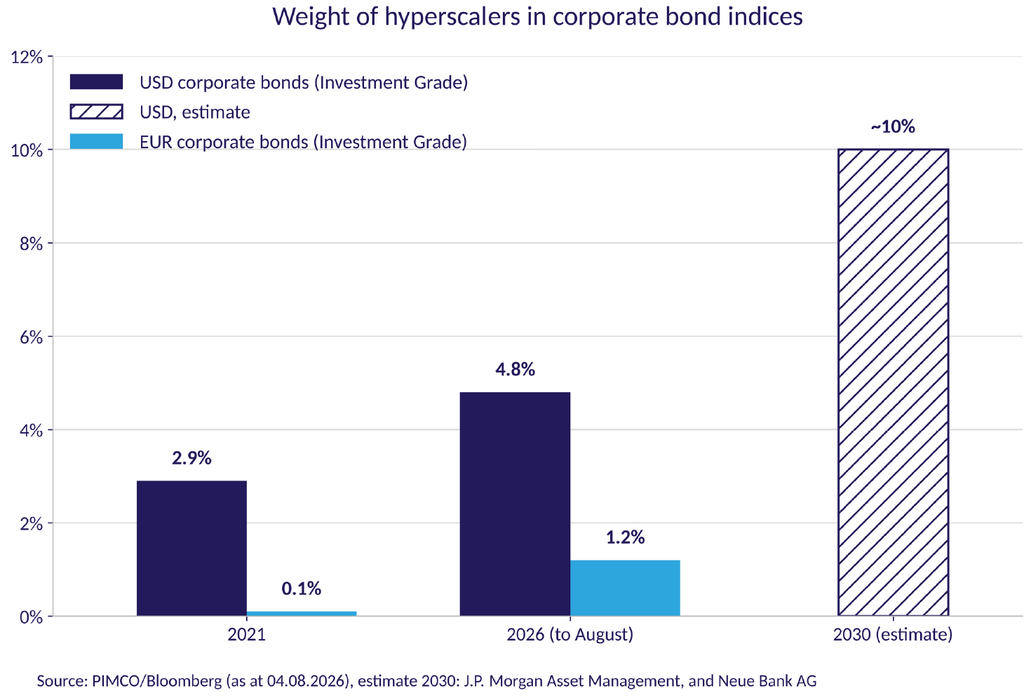
In corporate bonds, the hyperscalers are now being added, as they increasingly finance the construction of data centres via the capital market. Their share of new issuance in the US market for investmentgrade corporate bonds rose from around 2 per cent in the years 2022 to 2024 to an expected 9 per cent in 2026. In the corresponding index, Alphabet, Amazon, Meta, Microsoft and Oracle already account for just under 5 per cent, and by 2030 this could be around 10 per cent. In the euro area, the share is still lower at 1.2 per cent, but is also rising rapidly. This results in a double concentration: the same companies that dominate the equity indices are also gaining weight in the bond indices. Anyone who replicates both indices passively is betting twice on the success of artificial intelligence. First tensions are visible. The risk premiums on hyperscaler bonds have widened by around 30 basis points since the start of the year, those of the overall market by only 2 basis points. Oracle is now rated only BBBby S&P, the lowest rung in the investmentgrade range. A further downgrade could trigger forced selling by investors who are only permitted to hold investmentgrade bonds. At the same time, yields have risen: tenyear US Treasuries yield around 5.1 per cent, German Bunds 3.4 per cent and Swiss Confederation bonds 0.5 per cent. In bonds, we therefore do not orient ourselves solely by index weight. We prefer highquality corporate bonds and additionally rely on funds with a flexible approach not tied to an index (unconstrained), which can select issuers and maturities independently of index weights. In terms of maturities, we remain in the short to medium range.
Currencies
In currencies, too, concentration leads to an often overlooked concentration risk. In the MSCI World, US equities have a weight of more than 70 per cent. Anyone investing globally in equities therefore automatically bears a high dollar risk. For investors in Swiss francs and euros, this has been noticeable recently. The Swiss franc has regained its old strength: one euro costs around CHF 0.92, one dollar around CHF 0.82. The main driver is the budget crisis in France, which has made the franc sought after again as a safe haven. The dollar is benefiting in the short term from the US Federal Reserve’s rate hikes, but remains under structural pressure because of high debt. We therefore continue to hedge foreign currencies selectively and ensure that the dollar share of a portfolio is not determined solely by index weights.
Alternative Investments
Gold is one of the few investments that are largely independent of the AI boom. After the record high of around USD 5,400 per fine ounce at the end of January, however, the gold price has corrected significantly and is currently trading at around USD 3,900. Rising real interest rates and the stronger dollar in particular have weighed on it. It is noteworthy that investors continue to buy gold despite lower prices: in September, gold ETFs worldwide recorded inflows of 67 tonnes. Central banks are also continuing to diversify their reserves away from the dollar. Caution is advised with other alternative investments, as the link to AI is often greater than assumed. Demand for silver, copper and rare earths now depends heavily on data centres and grid expansion. In private equity infrastructure investments, data centres and grids already account for almost 20 per cent. In the private credit market, which has taken on an important part of AI financing, first turbulence is emerging. We are therefore maintaining a strategic gold position and see the recent decline as an opportunity to increase it gradually.
Our Contacts: